Contractor Lead Generation Website: Turn Your 2026 Site Into a Lead Machine With Reviews, Quote Forms, and Missed-Call Text-Back
A contractor website does not need to win design awards. It needs to make the phone ring, turn visits into quote requests, and help a homeowner feel confident enough to choose you over the other three companies they are comparing at 9:30 p.m. From a kitchen counter.
That is the standard in 2026. A nice-looking site is not enough. If your pages load slowly, bury your service areas, make people hunt for a phone number, or fail to reassure a nervous prospect, you are leaving money on the table. For home service companies, the website works best when it behaves like a sharp office manager, not a digital brochure. It should answer urgent questions, capture leads cleanly, and support your visibility in Google where local intent actually happens.
I have seen the same pattern across trades. The contractors who ask how to get more leads for contractors often assume they need more traffic first. Sometimes they do. More often, they need a better path from search to trust to contact. That path runs through three practical systems working together: a well-built site, strong reviews, and fast follow-up when a call or form comes in. If you miss one of those pieces, the whole machine gets weaker.
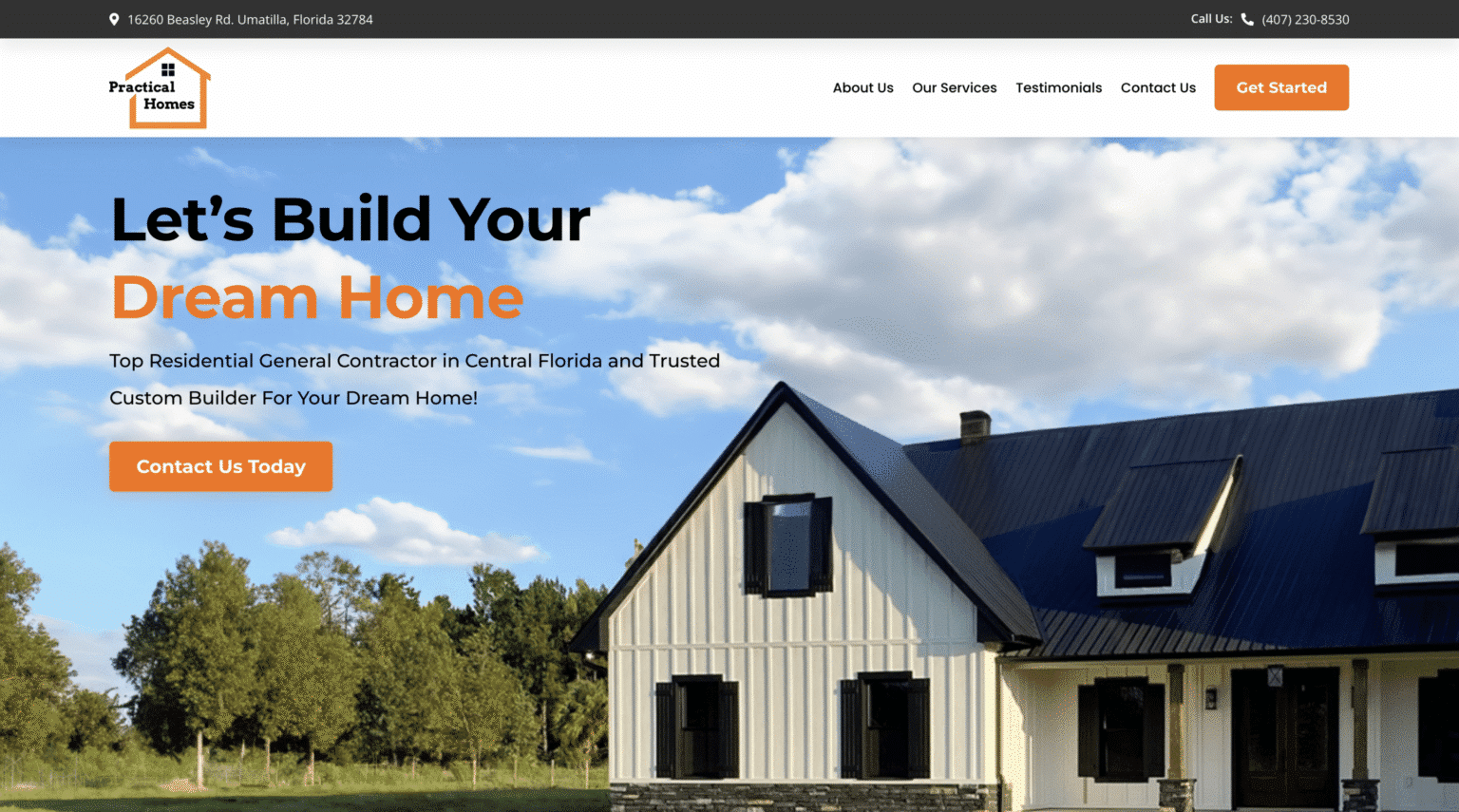
What a contractor lead generation website actually does
A true contractor lead generation website is built around local buyer behavior. People search with a problem in mind, not with abstract curiosity. A homeowner with a burst pipe, a flickering panel, a cracked slab, or storm damage wants proof, speed, and clarity. They are not reading your company history first. They want to know whether you serve their area, whether you handle their exact issue, and how quickly they can hear back.
That changes how the site should be structured. Instead of one general services page and a stock contact form, the site should support the actual way people search. A plumbing website design should make it easy for someone to land on a plumbing-specific service page, confirm the company serves their town, see recent reviews, and call or request a quote without friction. The same goes for electrician website design, foundation repair website design, water damage restoration website design, kitchen and bath remodeling website design, solar company website design, and fence contractor website design. Different trades need different messaging, but the conversion logic stays remarkably consistent.
The site also has to support search visibility. Local SEO for home service businesses is not just about title tags and city names. It is about matching the searcher’s intent with a page that genuinely fits what they need. If someone searches for electrical panel help in a nearby city and lands on a vague homepage, you have created extra work for them. If they land on a focused service page that clearly explains the service, the area covered, and how to contact you, the sale gets easier.
The homepage should reassure, not wander
Many contractor homepages try to say everything at once. They stack every service, every certification, every photo, and every message in a rush to look comprehensive. The result is usually muddy. Homeowners do not need your site to say everything in the first screen. They need it to answer the first few doubts.
A strong homepage should quickly make four things obvious:
- What you do
- Where you work
- How to reach you
- Why someone should trust you
That sounds simple, but it is surprising how many sites miss one or more of those basics. On mobile, the stakes are even higher. Google strongly recommends mobile-friendly pages and mobile versions of pages, and that practical reality shows up in lead volume every day. Most home service prospects are not doing deep desktop research. They are on a phone, often in a rush, and your site either makes the next step easy or it loses them.
One small but costly mistake is hiding the main call to action beneath oversized sliders, image-heavy banners, or vague branding language. If a homeowner has to scroll to find a number or figure out how to request service, the site is not pulling its weight. A contractor website that generates leads puts the contact path front and center. That can mean a prominent phone number, a visible quote form, and page sections that quickly reinforce capability and service area.
Reviews are not decoration, they are conversion fuel
Reviews do two jobs at once. First, they shape trust on your Google Business Profile. Google’s business tools explicitly support customer reviews and the ability to read and reply to them. Second, reviews help your site convert the traffic you already have. A homeowner comparing two contractors may not know how to evaluate technical skill, but they can evaluate patterns in customer feedback. They notice whether recent customers mention professionalism, communication, speed, cleanup, and whether the company solved the problem.
That is why reviews should not be tucked away on a single testimonials page that nobody sees. They should appear naturally on key service pages, your homepage, and contact-focused areas where trust matters most. For a remodeling company, a review that mentions staying on schedule and handling change orders calmly can matter more than generic praise. For a water damage restoration company, comments about rapid response and clear communication during a stressful event can be the deciding factor.
Freshness matters too. A lead prospect can tell when the most recent review feels old. You do not need hundreds to create confidence, but you do need a steady flow that shows the business is active and still delivering good experiences. That is especially important when your Google Business Profile for contractors is part of the buyer’s first impression. In many cases, people meet your company on Google before they ever visit your site.
Your Google Business Profile and your website should work like one system
A lot of contractors think of the website and the Google Business Profile as separate marketing tasks. They are not. They feed each other.
Google allows service-area businesses to use a service area instead of showing a storefront address, which is especially useful for contractors who travel to customers rather than operate from a customer-facing office. Business hours, categories, and service areas can also be added. That matters because it helps your profile more accurately reflect how the business operates, and it gives local prospects cleaner signals about whether you are relevant to their need.
Your website then needs to reinforce those signals. If your profile says you serve a region, your site should have pages that support that footprint with clear service and area relevance. If your profile highlights a category tied to a core service, your site should not bury that service three clicks deep. If your listed hours imply quick response, your site should make contact easy enough that a prospect can act on that expectation.
This is one reason local SEO for home service businesses often improves when companies get disciplined about structure. Optimize the Business Profile first, keep reviews coming in, build dedicated service pages, and make the site easy to call from mobile. Those are not flashy tactics, but they line up with how actual local leads happen.
Quote forms should reduce friction, not create homework
Contractors often ask whether short forms or detailed forms work better. The honest answer is that it depends on the trade, the urgency, and how your office handles follow-up. A water damage restoration lead is different from a kitchen remodel inquiry. One is immediate and high-stress. The other is often higher consideration, with a longer timeline.
Still, there is one rule that holds up well across trades: ask only for information you will actually use in the next step. Every extra field adds drag. If you ask a homeowner to upload plans, choose from a long menu of subservices, enter a budget range, and write a detailed project summary before you have even spoken to them, many will bounce. For emergency or fast-turn service work, keep the path lean. For bigger projects, collect enough context to help qualify and route the inquiry without making the form feel like an application.
I have seen forms improve conversion simply by moving from a cluttered, multi-section layout to a tighter version with plain labels and one clear button. The lesson was not that less information is always better. The lesson was that people respond when a form feels easy and respectful of their time.
Missed-call text-back closes the gap most contractors do not realize they have
This is one of the biggest practical opportunities for lead capture. A lot of contractors invest in traffic, rankings, and ads, then lose leads because nobody answered a call in time. That problem gets expensive fast.
Google’s Local Services guidance makes clear that leads can come through calls or message requests, and missed calls are part of lead handling. Business hours also connect back to the Google Business Profile. The local lead environment assumes responsiveness. If your company misses calls during lunch, after hours, while crews are on site, or when the office is slammed, you need a backup system.
A missed-call text-back does not replace a person. It buys you a second chance. It tells the lead, quickly, that their message matters and that someone will follow up. In real terms, that can be the difference between recovering a lead and losing it forever to the next contractor on the list.
The key is tone and timing. The text should sound human, acknowledge the missed call, and offer an easy next step. It should not feel robotic or overly clever. If the text arrives promptly and the follow-up comes soon after, the prospect still feels seen. If the text arrives but nobody calls back for hours, the value drops sharply.
For home service businesses, speed-to-lead is not a trendy phrase. It is basic sales hygiene. When a person has an urgent repair issue or is actively contacting contractors for quotes, the company that responds first often gets the conversation. Not always the job, but often the conversation, and that matters.
Service pages are where intent turns into leads
The homepage gets too much attention. For many contractors, service pages are where the real lead generation happens. These pages let you match search intent more precisely, support local SEO, and speak directly to the problem the customer is trying to solve.
A plumbing website design should not treat water heater replacement, drain issues, and leak detection as one blended topic if those are meaningful services in the business. An electrician website design should give core services room to stand on their own rather than forcing every searcher through a broad “electrical services” page. The same principle applies to foundation repair website design, solar company website design, and fence contractor website design. The more your pages align with actual buyer language and service categories, the easier it becomes for both Google and prospects to understand what you do.
This is especially useful for service-area businesses. If you cover multiple towns or parts of a metro, a strong site architecture can help users find the right combination of service and location relevance without resorting to thin, repetitive content. That is where judgment matters. You want enough specificity to support local intent, but not a pile of nearly identical pages that say little of value.
Different trades need different proof
One of the quickest ways to make a contractor site feel generic is to use the same trust elements in the same order for every trade. The basics may be website design for contractors similar, but the proof that persuades people changes by category.
For example, kitchen and bath remodeling website design usually benefits from showing process confidence. Homeowners want to know how communication works, what the project experience feels like, and whether the company can handle complexity without chaos. Water damage restoration website design usually leans harder on responsiveness, urgency, and reassurance. Foundation repair website design often needs to calm fear and explain credibility in a category where the stakes feel structural and expensive. Solar company website design may need to answer practical fit questions early. Fence contractor website design often benefits from straightforward service clarity and examples of completed work that help a homeowner picture the result.
This is why copy and design choices should not be copied blindly across trades. The lead generation principles are transferable. The buyer psychology is not always the same.
Track where the call came from, or your marketing decisions will stay fuzzy
A lot of contractors judge marketing by gut feel. That works up to a point, usually until spending rises or the pipeline gets uneven. Then the missing data hurts.
If the phone rings, you want to know whether the lead came from the Google Business Profile, the website, a specific service page, or another source in your mix. You do not need a complicated dashboard to start thinking more clearly. You do need enough visibility to answer practical questions. Which pages produce calls? Which services attract form fills? Are people finding you through branded searches, local map visibility, or direct page visits? Are calls being missed at certain times or on certain days?
These answers shape better decisions than broad assumptions. A contractor who learns that most high-intent calls come from a handful of well-built service pages will invest differently than one who assumes all traffic is equally valuable. A company that discovers it misses a meaningful share of first-time calls after 5 p.m. Will view missed-call text-back differently than a company that only looks at total lead count.
The 2026 standard is simpler than people think
There is no shortage of complicated advice in contractor marketing. Most of it distracts from the basics. The best-performing sites tend to get the fundamentals right over and over. They are easy to use on mobile. They support the Google presence instead of fighting it. They show clear service relevance. They make trust visible. They capture the lead without friction. They respond quickly when the phone is not answered.
Here is the practical stack that matters most:
- A mobile-friendly website with clear calls to action
- A well-maintained Google Business Profile with accurate service-area details, hours, and categories
- Recent reviews that build trust on Google and on the website
- Service pages aligned with how homeowners actually search
- Fast lead handling, including a plan for missed calls
That is not glamorous, but it is effective.
If your site looks fine but leads feel inconsistent, here is where to look first
Most contractors do not have a traffic problem in the abstract. They have a fit problem or a conversion problem. The business is visible enough to earn a shot, but the experience breaks somewhere between discovery and contact.
Sometimes the issue is that the website tries to serve everyone with generic language, so nobody feels directly spoken to. Sometimes the site lacks dedicated pages for the services that actually drive profit. Sometimes there are not enough reviews in sight to settle buyer nerves. Sometimes the quote form asks for too much. And very often, the office misses calls and never recovers the lead.
A strong contractor lead generation website fixes those failure points one by one. It does not rely on clever slogans. It reduces uncertainty. It helps a homeowner take the next step with confidence. That is why the best contractor website that generates leads usually feels straightforward. Every element has a job. Every page earns its place. Every contact path is there for a reason.
If you want more qualified leads in 2026, start there. Tighten the website. Strengthen the Google Business Profile for contractors. Keep reviews moving. Build pages around actual services and service areas. Make it painless to request a quote. And if your team cannot catch every inbound call live, add missed-call text-back so your marketing does not stop working the moment the line goes unanswered.
That is how a contractor site stops being an online brochure and starts behaving like a lead machine.